

What to Expect in Couples Counseling (An EFT Approach)
Updated: Mar 14
Emotionally Focused Couples Therapy (EFCT) is not about picking sides, deciding who’s right, or telling you what to do. It’s about understanding the cycle or the relationship dance you’ve been doing. This includes identifying your roles in the cycle: the pursuers, the withdrawers, the attachment ruptures, and the misunderstandings that will help you recognize and re-create a way to reach for each other again.
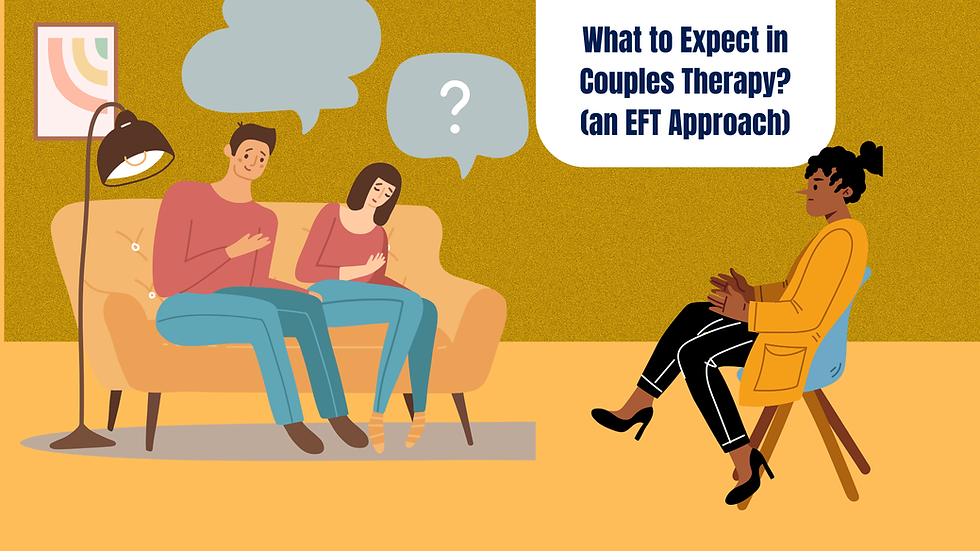
What EFCT looks like in practice:
• We slow things down
Instead of just jumping into problem-solving, we focus on what’s happening beneath the surface, like the fears, unmet attachment needs, and emotions that drive your reactions.
• I help you understand the cycle you’re stuck in
Most couples fight against each other when they actually need to be fighting together against the cycle that keeps pulling them apart. (you’ll hear me say it's not you vs you, but you both vs the cycle)
• You learn to express your needs without attacking or being defensive
When emotions make sense, communication becomes safer, so I lean into identifying feelings a lot. Feelings Wheels are great for that, and I use them to help you get there.

The role of an EFT therapist during couples counseling.
When I am providing couples counseling to clients, I play the following roles:
A Process Guide
I help you understand the emotional patterns driving your reactions —the fears, needs, and protective strategies underlying each interaction.
A Cycle-Mapper
I show you a visual of how your arguments, shutdowns, and escalations fit together in a predictable loop and how to step out of it.
A Safe Facilitator
I help you talk about the things you’ve both been avoiding because they feel too big, too sensitive, too hard, or too vulnerable to navigate alone.
An Educator
Awareness occurs through teaching, resourcing, and information gathering. EFT work asks you to try things that feel strange at first, like slowing down instead of reacting, sharing softer emotions instead of anger, and reaching toward your partner instead of pulling away.
These moves can feel awkward, unnatural, and maybe even unrealistic; however, they’re part of creating new ways for connection. I am here to teach you new emotional and communication skills.
A Consultant
I’m not here to “fix” you or your partner; I am here to walk with you through those shaky emotional moments until they start feeling less scary and more possible to do on your own.
Why the Work Starts at Home (and Why Counseling Alone Isn’t Enough)
One thing I always tell couples is this: the real work doesn’t just happen in the counseling room, it occurs at home, in the everyday moments where your patterns show up and you choose to engage differently.
Coming to counseling for one hour a week is a start, but it won’t magically rewrite a cycle you’ve been in for months or years. Counseling is the place where we learn the moves, and
home is where you practice the dance together. And just like any other skill, just showing up isn’t enough.
Couples who grow the most are the ones who are willing to try, continue through trial and error, laugh at the awkwardness, and keep going.
Tips, Tools, and Techniques Matter
Changing relationship dynamics means stepping into unfamiliar territory, so sometimes I’ll ask you to try some things like:
pausing mid-argument to name what you’re feeling underneath anger,
reaching for your partner in a new way,
practicing a softer emotional expression,
reflecting what you heard before responding,
slowing down to notice what’s happening in your body,
revisiting a vulnerable moment with compassion and curiosity
sharing uninterrupted eye contact
creating a mantra that is recited to remind you of your goal
And yes, it might be uncomfortable at first, but that is a part of the process. Some days you’ll leave feeling really good, and some days you’ll leave not feeling your best, and that’s okay.
Discomfort is not always a sign that something’s wrong.
Discomfort can be a sign that you’re trying something new.
And new is exactly what breaks old cycles.
My job is to support you through the discomfort and help you hold onto each other as you build healthier, more intentional ways of connecting, not just in the counseling space, but also in your daily lives, where it matters most.
Disclaimer: The information provided on this blog is for educational and informational purposes only and is not intended as medical or mental health advice. Accessing this content does not establish a therapist-patient relationship with Your Path Counseling Center.
© 2026 Your Path Counseling Center. All Rights Reserved.
Learn more about our services
Counseling: Adults, Children & Teens, Couples, and Families.
Specialized Care: Medication Management, Career Counseling, and Executive Coaching.
Professional Services: Clinical Supervision and Training for helping professionals.


Comments